Best Brunch Catering Ideas for Morning and Day Weddings
October 14, 2026

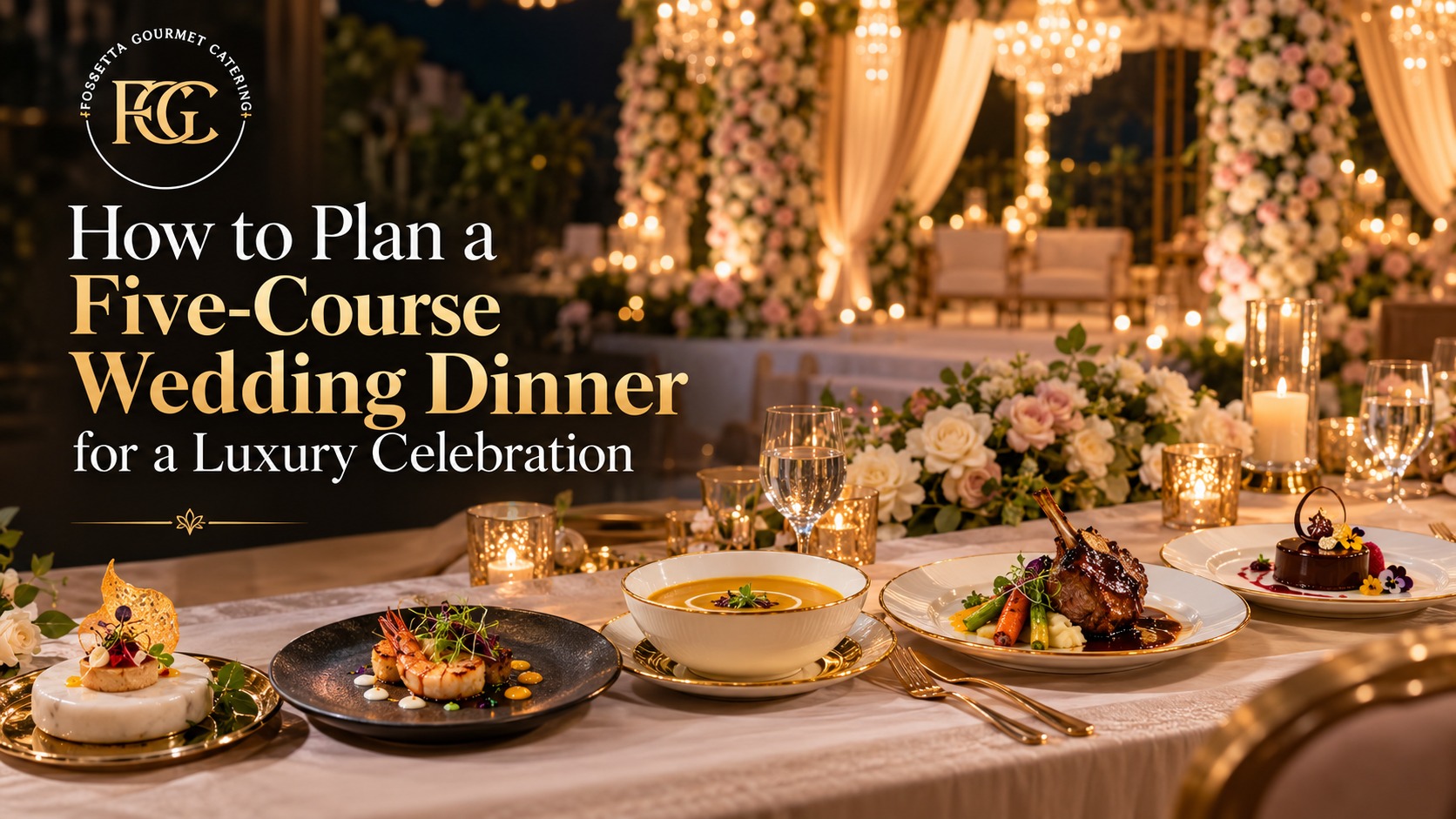
A luxury wedding dinner is about much more than serving expensive food. It is about creating a dining experience that feels thoughtful, beautifully paced, personal, and memorable.
At a wedding, guests may forget the exact shade of the flowers or the design of the invitation card after a few months, but they often remember a wonderful meal. They remember the starter that surprised them, the aroma of the main course, the dessert presentation, the way the tables were served, and how smoothly the entire dinner unfolded.
That is why a carefully planned five-course wedding dinner can become one of the most memorable parts of a luxury celebration.
Unlike a large buffet where guests choose several dishes at once, a five-course meal allows the experience to develop gradually. Each course has its own purpose, flavour profile, presentation and moment. When the menu is designed properly, one dish naturally leads to the next without leaving guests feeling either hungry or overwhelmed.
If you are planning a sophisticated wedding and want the dinner to feel more like a curated fine-dining experience, this guide explains how to plan a five-course wedding dinner from beginning to end.
A traditional five-course dinner usually includes five separate stages of food.
The exact format can change according to the wedding theme, cuisine and guest preferences, but a luxury wedding menu may follow this structure:
Amuse-bouche or light opening bite
Starter or appetizer
Soup, salad or intermediate course
Main course
Dessert
For an Indian wedding, this structure can be adapted creatively.
The first course might be a beautifully plated Indian-inspired bite. The second could introduce a richer starter. The third course might refresh the palate before the main course. The fourth becomes the centrepiece of the dinner, followed by an elegant dessert experience.
There is no rule saying a five-course wedding dinner must be completely European or Western.
In fact, some of the most interesting luxury wedding menus combine Indian culinary traditions with modern plating, international techniques and carefully balanced flavours.
The goal is not simply to serve five dishes.
The goal is to create five connected dining moments.
One of the biggest mistakes couples make is choosing dishes before deciding what kind of dining experience they want.
Before discussing starters, curries or desserts, think about the atmosphere of the celebration.
Ask yourself:
Is the wedding formal or relaxed?
Is it a daytime or evening celebration?
Is the venue indoors or outdoors?
Is the wedding traditional, contemporary or destination-inspired?
Will guests be seated throughout dinner?
Do you want completely plated service or a combination of plated courses and live counters?
Is the overall mood royal, modern, minimal or festive?
A five-course menu for a candlelit palace wedding may look completely different from one created for a modern luxury wedding at a contemporary hotel.
The menu should feel like part of the wedding rather than a separate element.
For example, a modern wedding might feature delicate plated portions, global flavours and artistic presentation.
A heritage-inspired celebration might explore regional Indian recipes presented in a refined way.
A destination wedding could include ingredients or dishes inspired by the location.
Once the overall experience is clear, planning the food becomes much easier.
A luxury menu still needs to be enjoyable for the people attending the wedding.
Before designing the courses, understand your guest profile.
Consider:
Number of vegetarian guests
Vegan requirements
Jain food preferences
Gluten sensitivities
Nut allergies
Children attending the wedding
Elderly guests
International guests
Guests who may prefer traditional Indian flavours
A menu might look impressive on paper but fail if a large portion of guests cannot comfortably enjoy it.
The best wedding menus achieve a balance between creativity and familiarity.
You can introduce guests to something new while still giving them flavours that feel approachable.
For example, instead of making every course experimental, you might serve an innovative first course followed by familiar Indian flavours presented in a contemporary style.
Good luxury catering should never make guests feel confused by the menu.
It should make them curious.
The first course sets expectations for everything that follows.
It should be small, attractive and full of character.
This course is sometimes known as an amuse-bouche—a bite-sized dish designed to awaken the palate.
At an Indian luxury wedding, this could be interpreted in many interesting ways.
Ideas may include:
miniature avocado pani puri
truffle-infused dahi puri
beetroot and goat cheese bite
delicate paneer tikka canapé
mushroom galouti on a crisp base
smoked yogurt chaat bite
tiny kebab with a modern garnish
small seasonal vegetable tart
The important word here is small.
Guests have several courses ahead of them. The opening dish should create excitement rather than fill the stomach.
Presentation also matters greatly at this stage.
An elegant first plate instantly tells guests that dinner is going to be different from a conventional wedding buffet.
The second course can be slightly richer and more substantial.
This is where the menu starts developing character.
Depending on the theme, you could choose Indian, Mediterranean, Pan-Asian, Middle Eastern or fusion flavours.
Vegetarian options might include:
tandoori broccoli with almond cream
stuffed morel mushrooms
paneer with smoked pepper sauce
crispy lotus stem with Asian flavours
asparagus and cheese roulade
beetroot galouti
wild mushroom kebabs
Non-vegetarian possibilities might include:
delicate fish tikka
chicken roulade
lamb galouti
grilled prawns
herb-crusted fish
small kebab tasting plates
The starter should not compete with the main course.
Avoid oversized portions and very heavy sauces.
Remember that luxury often comes from restraint.
A beautifully composed plate containing a few thoughtfully prepared elements can feel far more sophisticated than an overcrowded dish.
After two flavourful courses, guests usually benefit from something lighter.
This middle course acts as a bridge between the appetizers and main course.
Depending on the season and menu style, it could be:
a light soup
a fresh salad
a small sorbet
a delicate broth
a seasonal vegetable preparation
a palate cleanser
For winter weddings, a warm soup can work beautifully.
Options such as roasted pumpkin soup, mushroom cappuccino, asparagus soup or a light tomato consommé can bring warmth without making the meal too heavy.
For warmer months, a refreshing salad or sorbet can provide balance.
Imagine a citrus sorbet served before the main course. Its purpose is not simply to be another dish; it refreshes the taste buds so guests can enjoy the next course fully.
This attention to pacing is one of the details that separates ordinary wedding food from a genuine fine-dining experience.
The main course is usually the most substantial part of a five-course wedding dinner.
By this point, the previous courses should have built anticipation without making guests feel full.
The main course should feel satisfying, comforting and special.
For Indian luxury weddings, this does not mean abandoning familiar dishes.
Classic flavours can feel extremely elegant when ingredients, portions and plating are handled carefully.
A vegetarian main course might combine elements such as:
slow-cooked dal
paneer or seasonal vegetable preparation
aromatic rice
small Indian breads
premium mushroom preparations
regional vegetable dishes
refined gravies
Non-vegetarian menus might feature:
slow-cooked lamb
delicately spiced chicken
grilled fish
aromatic biryani
regional meat dishes
Another approach is to offer guests a choice of two main courses while keeping the earlier courses fixed.
For example:
Vegetarian: Wild mushroom and paneer composition with saffron rice.
Non-Vegetarian: Slow-cooked lamb with aromatic rice and seasonal accompaniments.
Choice improves guest comfort without turning the five-course dinner into a large buffet.
Dessert is the final impression of the meal.
After four courses, a very heavy dessert may be too much. The best final course feels indulgent without being overwhelming.
Luxury wedding dessert ideas could include:
dark chocolate fondant
pistachio and rose dessert
baked cheesecake
saffron rasmalai interpretation
gulab jamun with modern plating
seasonal fruit tart
chocolate mousse
kulfi with contemporary accompaniments
miniature dessert tasting trio
A dessert trio works particularly well for weddings because guests can experience several flavours without receiving a large portion of one item.
For example:
Rose Rasmalai | Dark Chocolate Mousse | Pistachio Kulfi
This creates visual interest while also combining Indian and contemporary flavours.
Tea, coffee or petit fours can follow dessert if the event format allows.
When planning a five-course wedding menu, every dish must be considered as part of the whole meal.
Five excellent dishes do not automatically create an excellent five-course dinner.
Imagine serving a creamy starter, creamy soup, rich gravy, buttery rice and dense chocolate dessert.
Individually, every dish may taste good.
Together, however, the meal would feel exhausting.
A well-designed menu changes texture, temperature, intensity and flavour throughout the evening.
A simple balance could look like:
Course 1: Fresh and crisp
Course 2: Warm and savoury
Course 3: Light and refreshing
Course 4: Rich and satisfying
Course 5: Sweet and elegant
That natural progression keeps guests interested until the final plate.
Five-course dining is very different from buffet dining.
Each portion should be deliberately smaller because guests will receive several dishes.
Oversized servings in the early courses are one of the easiest ways to ruin the experience.
Guests may become full before the main course arrives.
Work with your caterer to determine appropriate serving sizes based on the number of courses.
Luxury dining does not depend on enormous portions.
Instead, the focus is on quality ingredients, thoughtful composition, refined flavours and presentation.
Pacing is one of the most overlooked parts of wedding dinner planning.
Serve courses too quickly and guests may feel rushed.
Wait too long and the energy at the tables disappears.
For most formal dinners, each course should arrive after guests have comfortably completed the previous one.
Timing must also consider:
speeches
couple entry
performances
wedding rituals
music
photography
entertainment
If a 20-minute performance begins immediately after appetizers, kitchen timing needs to adjust.
This is why communication between the catering team, event planner and venue staff is essential.
A luxury dining experience depends as much on coordination as it does on cooking.
A classic five-course meal is usually associated with plated service.
However, Indian weddings often include hundreds of guests, making completely plated dinners operationally complex.
A hybrid format can sometimes provide the best experience.
For example:
welcome snacks served during cocktails
first two courses plated
main course served at premium live counters
dessert plated or presented through an elegant dessert station
Another possibility is offering a formal plated dinner for an intimate wedding event such as the engagement dinner, rehearsal dinner or family celebration, while using a broader buffet format for the main wedding.
Choose the format according to guest numbers, venue facilities and the atmosphere you want to create.
Live cooking stations can bring excitement to a wedding, but they should support the five-course concept rather than distract from it.
Instead of creating twenty unrelated counters, select a small number that genuinely add to the experience.
Ideas include:
live pasta station
gourmet chaat counter
dim sum station
fresh grills
hand-tossed pizza
live dessert finishing
regional Indian cooking station
Guests enjoy seeing chefs prepare dishes in front of them, and the aroma creates another layer of sensory experience.
The key is curation.
More counters do not always mean a better wedding.
A carefully planned selection usually feels more premium.
One of the best ways to make a luxury wedding dinner memorable is to include something personal.
Maybe the couple had their first date at an Italian restaurant.
Perhaps one family comes from Rajasthan while the other comes from Bengal.
Maybe the bride loves traditional Delhi chaat and the groom prefers Japanese food.
These details can inspire individual courses.
You could create a menu that quietly tells the couple's story.
A wedding dinner might move from an Indian street-food-inspired opening to a global starter, followed by a regional main course and a dessert inspired by a childhood favourite.
Personalisation creates something money alone cannot buy: meaning.
A luxury menu does not always require imported ingredients.
Fresh seasonal ingredients can often produce better flavour.
Summer weddings may work beautifully with:
mango
citrus fruits
watermelon
fresh herbs
lighter sauces
cooling beverages
Winter weddings can explore:
root vegetables
mushrooms
warming spices
nuts
rich broths
slow-cooked dishes
Your wedding date should influence your menu.
Guests attending an outdoor wedding in June may not enjoy the same dishes that work perfectly at a December celebration.
Guests taste with their eyes before they taste with their palate.
This is particularly true at luxury weddings.
Presentation includes much more than how food looks on a plate.
Consider:
crockery
glassware
cutlery
serving trays
table linen
garnishes
plate design
buffet décor
live counter styling
lighting
The food presentation should complement the broader wedding décor rather than compete with it.
For a minimal wedding, clean white crockery and subtle plating may work beautifully.
For a royal celebration, richer textures and traditional serving details might feel more appropriate.
Consistency creates sophistication.
Beverages should never be treated as an afterthought.
A five-course dinner can be supported with carefully selected:
mocktails
infused water
fresh juices
traditional beverages
tea
coffee
sparkling drinks
Instead of offering twenty random beverages, consider pairing different drinks with parts of the meal.
A light citrus drink may complement appetizers, while a subtle traditional beverage could accompany Indian flavours.
At the dessert stage, coffee or artisanal tea can provide a polished finishing touch.
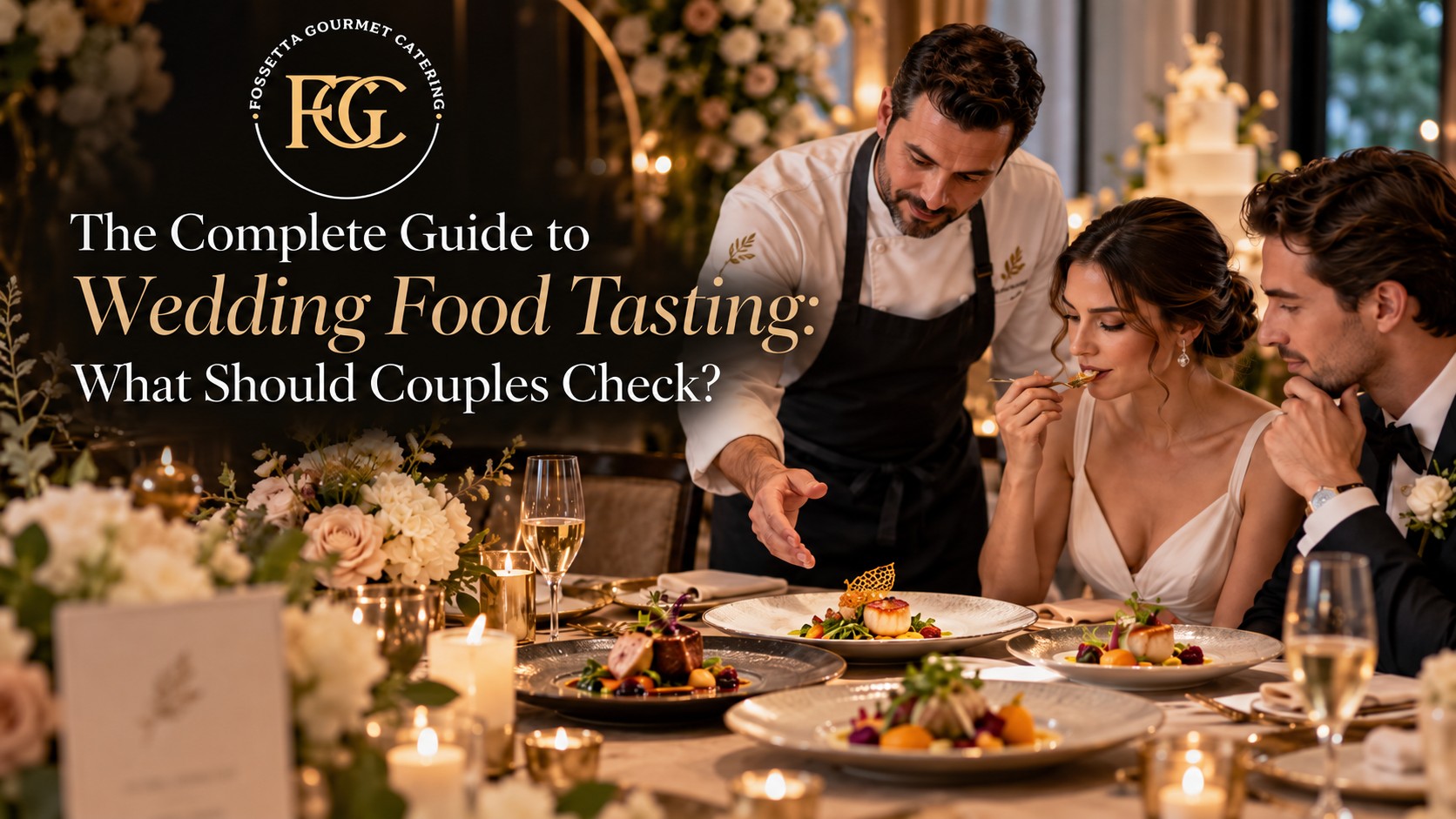
Never finalise a luxury wedding menu based entirely on a printed proposal.
A food tasting gives couples an opportunity to evaluate the actual experience.
During the tasting, pay attention to:
Does every dish taste balanced?
Will guests comfortably enjoy all five courses?
Does the plate look appropriate for your wedding style?
Do the dishes work well together?
Are too many courses soft, creamy or fried?
Are vegetarian, vegan or allergy-sensitive options equally thoughtful?
Use the tasting to improve the menu rather than simply approve it.
Small adjustments at this stage can make a noticeable difference during the wedding.
Before finalising your five-course wedding dinner, discuss important practical details with your caterer.
Ask:
How will the five courses be timed?
How many service staff will be required?
Can vegetarian and non-vegetarian courses be served simultaneously?
How will special dietary requests be handled?
Is the kitchen infrastructure at the venue sufficient?
Can the menu be prepared consistently for our guest count?
Will a tasting be arranged?
How will food be kept at the correct temperature?
What is the backup plan if the event schedule changes?
Can dishes be customised around our family preferences?
A beautiful menu is only successful when the catering team can execute it consistently.
Even luxury weddings can suffer from poor menu planning.
Here are some common mistakes.
Rich food from beginning to end can leave guests uncomfortable.
Create variation.
Presentation matters, but taste matters more.
The dish should still be enjoyable after the photographs are taken.
Not every guest wants completely unfamiliar flavours.
Mix creativity with comforting options.
Luxury hospitality means making every guest feel considered.
A five-course dinner requires controlled serving sizes.
Even amazing food loses its charm when guests wait too long between courses.
More food does not necessarily create more luxury.
Thoughtful selection often feels more sophisticated than endless choice.
For couples planning an elegant wedding, choosing the right catering approach is about creating harmony between food, service and celebration.
At Fossetta Gourmet Catering, the focus is on creating wedding dining experiences where flavour, presentation and hospitality work together.
Whether the celebration calls for an intimate plated dinner, destination wedding dining, thoughtfully designed live counters or a larger luxury wedding menu, the planning should begin with understanding the couple, their guests and the atmosphere they want to create.
A five-course wedding menu can also be customised around Indian favourites, international cuisines, modern fusion ideas and dietary preferences.
The objective should never be to make the menu complicated simply because the wedding is luxurious.
True luxury lies in making every element feel effortless.
Learning how to plan a five-course wedding dinner begins with understanding that the experience is just as important as the dishes themselves.
A memorable dinner should have rhythm.
The first bite should create curiosity.
The starter should build excitement.
The middle course should refresh the palate.
The main course should provide comfort and satisfaction.
And dessert should end the experience beautifully.
Above all, the menu should feel personal.
Luxury is not defined by how many expensive ingredients appear on the plate or how many counters are installed at the venue. It comes from attention to detail, thoughtful hospitality, high-quality food and an experience that feels created especially for the people attending.
When the courses are carefully planned, portions are balanced, service flows smoothly and the menu reflects the couple's personality, dinner becomes more than one part of the wedding.
It becomes one of the stories guests take home with them.
And that is what a truly memorable luxury wedding celebration should achieve.