Planning a wedding in Gurgaon is an exciting experience, but it also involves hundreds of small decisions. From selecting the venue and décor to finalising the guest list, entertainment and photography, every element has a role in making the celebration memorable. Among all these decisions, food deserves special attention because it is one of the few things every guest personally experiences.
A beautiful venue can create the first impression, but a well-planned wedding menu can leave a lasting one. Guests remember the aroma of freshly prepared starters, the excitement around a live food counter, the comfort of a perfectly served main course and, often, that one dessert they couldn't resist trying twice. This is why choosing the right wedding catering in Gurgaon is not simply about selecting dishes from a menu. It is about creating a dining experience that fits the occasion and feels effortless for the guests.
Gurgaon has become one of the most popular destinations for weddings and private celebrations in the Delhi NCR region. With luxury hotels, farmhouses, banquet venues, outdoor lawns and sophisticated event spaces, couples have plenty of options for creating a personalised celebration. At the same time, this variety means wedding catering needs thoughtful planning. A menu that works perfectly for an intimate indoor celebration may not work in exactly the same way for a large outdoor wedding.
Whether you are planning a traditional Indian wedding, an intimate engagement celebration, a grand reception or a destination-style wedding experience, avoiding common catering mistakes can help you make better decisions. Here are seven important mistakes to avoid when planning wedding catering services in Gurgaon.
1. Choosing the Menu Without Understanding Your Guests
One of the first mistakes couples make is selecting a menu based entirely on their own preferences. It is natural to choose dishes that you personally love, but a wedding menu needs to satisfy a much larger and more diverse group of people.
Think about your guest list before you start finalising dishes. A typical Indian wedding may have young children, teenagers, young adults, parents, grandparents and guests travelling from different cities. Their food preferences can be very different.
Some guests may enjoy traditional Indian cuisine, while others may look forward to contemporary or international flavours. Some may prefer vegetarian dishes, while others expect non-vegetarian options. There may also be guests who follow Jain dietary practices or have specific food allergies and restrictions.
A good wedding menu finds a balance between these preferences.
Instead of trying to provide every possible cuisine, focus on creating a menu with enough variety to make everyone comfortable. Traditional favourites can be combined with modern dishes, regional specialities, live counters and thoughtfully selected desserts.
For example, a wedding menu could include familiar Indian starters alongside a contemporary appetiser section. A live chaat counter could provide an interactive experience, while a well-planned main course could include both traditional and modern options. Desserts can then provide a combination of classic Indian sweets and contemporary creations.
The key is not to ask, "How many dishes can we serve?"
The better question is, "Will our guests enjoy and remember the food we serve?"
Experienced wedding caterers in Gurgaon can help couples answer this question by understanding the guest profile before recommending a menu. A professional caterer can also suggest ways to create variety without making the menu unnecessarily large.
Consider the age and background of your guests
A menu designed for a young crowd may be very different from one planned for a family wedding with several generations attending. Children may prefer familiar dishes, older guests may appreciate traditional recipes, while younger guests may be excited by fusion dishes and interactive food stations.
If guests are travelling from different parts of India, regional preferences can also influence menu selection.
This does not mean you need to create separate menus for everyone. Instead, choose a thoughtful combination that gives guests enough choice.
Don't forget dietary requirements
Dietary preferences should be discussed with the caterer well before the wedding. Jain food, vegetarian food, allergy-related requirements and other restrictions should be considered during menu planning rather than being handled at the last minute.
Clear communication helps the catering team prepare suitable options and organise them properly at the venue.
A wedding should be enjoyable for everyone, and thoughtful food planning is one simple way to make guests feel considered.
2. Assuming More Dishes Mean Better Catering
Indian weddings are often associated with elaborate food spreads. Couples and families sometimes feel that a larger buffet automatically creates a more impressive celebration.
But more dishes do not always mean better catering.
A buffet containing dozens of items may look impressive, but too much variety can make the experience confusing and can put additional pressure on the kitchen and service team.
When a menu becomes unnecessarily large, several things can happen. Guests may struggle to decide what to eat. Similar dishes may compete for attention. Popular counters can become crowded. The catering team has more preparations to manage, making consistency more challenging.
A carefully curated menu can often create a stronger impression than an oversized one.
Think of your menu as a complete dining journey. Start with welcoming beverages and appetisers, introduce interesting live counters or food stations, move into a balanced main course and finish with desserts that provide a satisfying conclusion.
Give your menu a personality
A wedding menu should feel connected to the celebration.
Perhaps you want to highlight regional Indian cuisine. Maybe you prefer modern fusion dishes. You might want a luxurious gourmet experience or a menu inspired by family traditions.
Choosing a few signature dishes can give your wedding catering its own identity.
A chef-created appetiser, a traditional family recipe, an interactive chaat station, a gourmet dessert counter or a regional speciality can become something guests remember.
This approach is particularly effective for luxury wedding catering, where the focus is increasingly shifting from quantity to quality, creativity and presentation.
Think about food wastage
Oversized menus can also lead to unnecessary food wastage. When guests are presented with too many similar options, they may take small portions of several dishes without finishing them.
A professional caterer can estimate quantities according to the number of guests, menu structure, event duration and expected consumption.
The objective is to have enough food for everyone without creating unnecessary excess.
Good catering is about abundance, but it is also about thoughtful planning.
3. Choosing a Caterer Based Only on the Lowest Price
Wedding budgets matter. There is nothing wrong with comparing quotations or trying to manage catering costs responsibly. The mistake is choosing a caterer only because their quotation is the cheapest.
Two catering companies can offer similar-looking menus at very different prices, but the actual experience may be completely different.
The cost of wedding catering can include much more than ingredients. It may involve chefs, kitchen staff, service personnel, crockery, cutlery, equipment, transportation, live counters, beverages, food presentation, setup and post-event service.
Before comparing prices, understand exactly what each quotation includes.
Ask questions such as:
- How many service staff are included?
- Is crockery included?
- Are live food counters included?
- Is the setup included?
- Is transportation included?
- Are beverages included?
- Are there additional service charges?
- Is GST included?
- What happens if the guest count changes?
- Is a food tasting available?
These details can make a significant difference.
Look at value instead of just price
The right wedding caterer in Gurgaon should offer a combination of food quality, service, creativity, reliability and professional execution.
A lower quotation may initially look attractive, but if it comes with limited staff, fewer services or lower-quality ingredients, the apparent saving may not be worth it.
On the other hand, the most expensive caterer is not automatically the best choice either.
The right decision comes from comparing the overall value.
Always consider a food tasting
A tasting gives you an opportunity to understand the caterer's cooking style before making a final decision.
You can evaluate taste, presentation, portion sizes and the quality of ingredients. It is also the right time to discuss changes to the menu.
If you want a particular dish to be less spicy, more traditional, more contemporary or presented differently, these conversations are easier to have before the wedding.
A tasting should not be treated as just another formality. It is one of the most useful steps in selecting wedding catering services in Gurgaon.
4. Ignoring Food Quality and Consistency
A dish can taste excellent when prepared for a small tasting, but maintaining that quality for several hundred guests is a completely different challenge.
Large-scale wedding catering requires planning, experienced chefs, proper equipment and strong kitchen management.
The food needs to maintain the right taste, temperature, texture and appearance throughout service.
For example, fried appetisers need to retain their crispness. Breads should be served fresh. Hot dishes need appropriate temperature management. Live counters require continuous preparation. Desserts may require specific storage conditions.
These details may not always be visible to the guests, but they strongly influence their experience.
Ingredient quality matters
Fresh ingredients can make a noticeable difference to the final dish. Fresh vegetables, herbs, spices, dairy products and quality meats contribute to flavour and texture.
When a menu contains simple dishes, ingredient quality becomes even more important because there are fewer elements to hide behind.
A professional catering company should be able to explain how ingredients are sourced, prepared and managed for large events.
Consistency matters just as much as taste
Imagine one guest receiving a beautifully prepared starter while another receives one that is cold or overcooked.
At a wedding, every guest should receive the same standard of food.
Consistency requires systems.
Experienced wedding caterers in Gurgaon understand how to organise kitchen operations, food preparation, replenishment and service so that quality remains stable throughout the event.
This is one of the reasons professional catering involves much more than simply having talented chefs. It requires an entire team working together.
5. Forgetting About the Wedding Schedule
Food needs to fit into the wedding rather than compete with it.
This is an important point that is sometimes overlooked during planning.
A wedding may include ceremonies, photography, speeches, dance performances, entertainment and other activities. If the schedule changes, food service may also need to change.
Suppose the ceremony takes longer than expected. Hundreds of guests may suddenly arrive at the dining area at almost the same time.
If the catering team has not prepared for that possibility, queues can form quickly.
This is particularly important for large weddings.
Plan the food flow
The catering team should understand:
- Guest arrival time
- Welcome drink service
- Ceremony timings
- Starter timings
- Main-course timing
- Entertainment schedule
- Dessert service
- Expected departure time
This allows the team to prepare food and staff accordingly.
Live counters need extra attention
Live food counters are increasingly popular because they create interaction and allow guests to enjoy freshly prepared food.
But they need proper planning.
The counter needs enough space for the chef, equipment, ingredients and guests. Electricity may be required. Staff need room to work. The station should be placed where guests can access it easily without blocking other areas.
A live counter positioned in the wrong location can create unnecessary congestion.
A well-planned station, however, can become one of the most enjoyable attractions at the wedding.
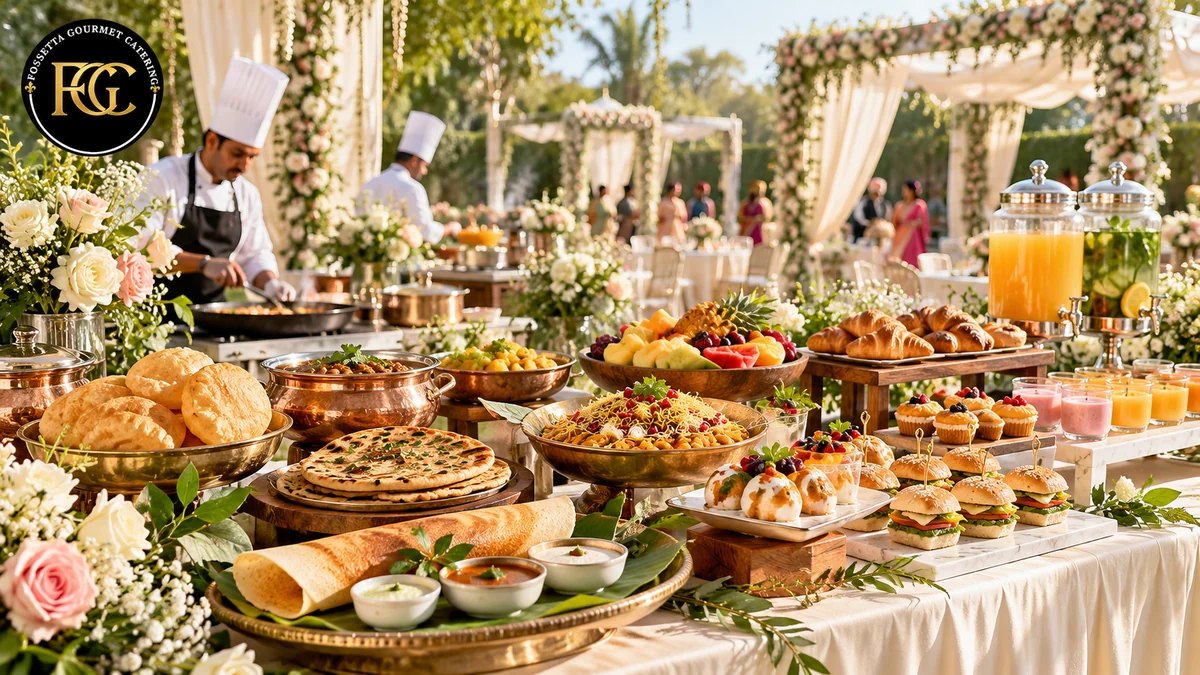
Fossetta's approach to interactive food experiences demonstrates how familiar foods can become part of the entertainment and atmosphere of an event. The idea is not simply to place food on a table but to make the dining experience engaging.
6. Overlooking Dietary Requirements
Modern weddings bring together guests with different dietary preferences and restrictions.
Some guests may prefer vegetarian food. Others may require Jain options. Some may have allergies or specific dietary requirements.
These needs should be communicated to the catering team early.
Waiting until the wedding day can create unnecessary complications.
If Jain food is required, for example, the catering team needs to understand the preparation requirements rather than simply removing a few ingredients from an existing dish.
Similarly, guests with allergies may need clear information about ingredients and preparation.
Make suitable options easy to identify
Food labelling can be helpful at large weddings. Clearly marked vegetarian, Jain or other specialised food sections can make it easier for guests to make their choices.
Service staff should also be informed about the different food categories so they can answer basic questions.
The goal is to make guests feel comfortable rather than making them repeatedly ask whether they can eat something.
An inclusive menu does not have to become complicated. It simply needs to be planned thoughtfully.
7. Not Coordinating With the Venue and Event Team
Even an excellent menu can face problems if the caterer, venue and wedding planner are not communicating properly.
Catering requires practical arrangements that should be discussed before the event.
The team may need access to:
- Kitchen facilities
- Preparation areas
- Storage space
- Electricity
- Water
- Service entrances
- Dining areas
- Live-counter spaces
- Staff areas
The venue layout should be understood before the wedding day.
Guest movement is important
Imagine the buffet placed directly beside the entrance. Guests arriving at the venue may immediately create a crowd.
Or imagine a popular dessert counter placed in a narrow corridor. Guests may gather around it and block movement.
Good catering layout considers how people will move through the venue.
The placement of food stations, buffet counters, beverages and desserts should encourage smooth movement rather than create bottlenecks.
Coordinate with the wedding planner
The catering team should know the complete event schedule and the wedding planner should know the catering plan.
This coordination becomes even more important when multiple events are taking place at the same venue.
Clear communication before the wedding reduces the possibility of last-minute problems.
Professional wedding catering services should ideally have a detailed operational plan covering food preparation, service, staffing, setup and replenishment.
Why Professional Wedding Catering Makes a Difference
Wedding catering is ultimately a team effort.
Chefs are responsible for the food, but service staff deliver it. Supervisors coordinate stations, kitchen teams manage preparation and event managers ensure that everything moves according to the plan.
For a large wedding, staffing needs to be matched with the number of guests and the type of service.
A buffet requires a different service structure from a plated dinner. Live counters require additional chefs and equipment. A destination wedding may require additional logistical planning.
When the team is properly organised, guests may never notice the amount of work happening behind the scenes — and that is exactly what good catering should feel like.
The service should feel smooth.
Food should be available when guests want it.
Popular dishes should be replenished quickly.
Dining areas should remain clean.
Staff should be attentive without becoming intrusive.
And the menu should feel like a natural part of the celebration.
This is especially important for couples planning luxury wedding catering in Gurgaon, where guests often expect a higher level of presentation, hospitality and attention to detail.
How to Plan a Better Wedding Menu in Gurgaon
Once you understand the common mistakes, planning becomes much easier.
Start by understanding your guests. Then decide the overall style of the wedding. Is it traditional, modern, intimate, luxurious or destination-inspired?
Next, decide how you want guests to experience the food.
Do you want a traditional buffet?
Would live counters add something special?
Would a plated dinner suit the occasion?
Do you want a combination of Indian and international cuisines?
Once the service style is clear, the menu becomes easier to develop.
Then work with your caterer to balance variety, quality and quantity.
Rather than choosing dishes one by one, think about the complete menu as a journey.
Welcome beverages should set the tone.
Starters should create excitement.
Live stations can add interaction.
The main course should provide satisfying and familiar choices alongside a few interesting options.
Desserts should end the experience on a memorable note.
This approach creates a menu that feels intentional rather than simply crowded.
Final Thoughts
Planning wedding catering in Gurgaon requires more than choosing attractive dishes from a menu. It requires understanding your guests, managing the budget, evaluating food quality, considering dietary requirements and coordinating every aspect of service with the venue and wedding schedule.
The seven mistakes discussed in this guide are easy to overlook, especially when couples are managing many other aspects of their wedding. But avoiding them can make a significant difference.
Do not choose a caterer only because they offer the lowest price. Do not assume that a longer menu automatically means better food. Do not ignore dietary preferences. Do not wait until the last minute to coordinate with your venue. Most importantly, do not think about catering as simply food being served at a wedding.
Think about the experience.
Guests should feel welcomed when they arrive. They should have interesting choices without feeling overwhelmed. Food should be fresh, well presented and served at the right time. Live counters should feel exciting rather than crowded. Service should be professional and effortless.
At Fossetta, the philosophy of catering goes beyond preparing food. With a focus on culinary creativity, quality ingredients, presentation and personalised experiences, the aim is to make food an integral part of the celebration. From wedding catering in Gurgaon and destination weddings to private luxury events and corporate occasions, every event can be designed around its own personality and requirements.
A thoughtfully planned wedding menu does more than feed your guests.
It becomes part of the memories they take home.
And when the last plate is cleared, the lights begin to dim and the celebration comes to an end, that is often what great catering is all about — leaving guests with one more reason to remember your wedding.